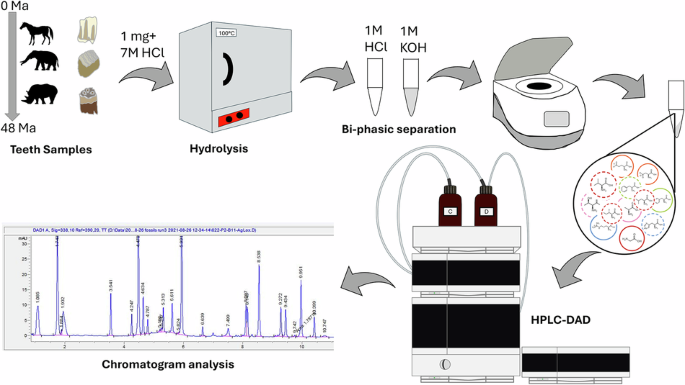
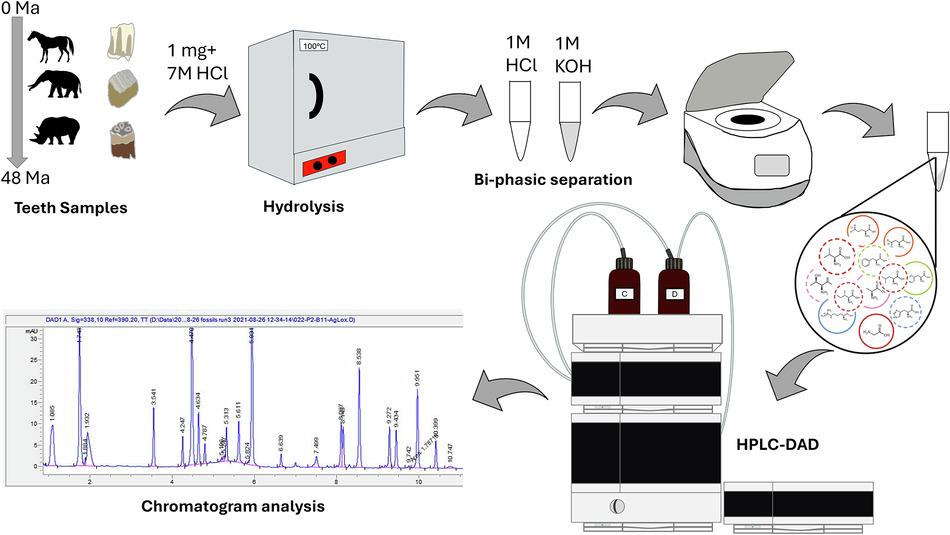
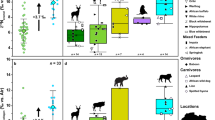

Tooth enamel has long been considered one of the most promising places to search for ancient biomolecules, and a new study pushes that idea much further back in time. Researchers examining modern and fossil enamel from large herbivorous mammals found that total hydrolysable amino acids can survive in enamel for tens of millions of years, with detectable preservation reaching as far back as 48 million years.
The work focused on enamel from horses, rhinos, and proboscideans collected across a range of fossil ages and taphonomic settings. Despite enamel being made of only about 1% organic matter, the team found that amino acids persist well into the Eocene. That makes enamel a remarkably durable substrate for molecular studies, especially compared with many other tissues that break down far more quickly after burial.
One of the most interesting results was the behavior of the intra-crystalline organic fraction. The researchers found a sharp early decline in amino acids during the first 100,000 years, followed by a much slower phase of loss or stabilization. After that initial drop, the remaining signal appears to be relatively resilient, suggesting that organic material trapped within the enamel crystal structure can act like a protected reservoir over deep time.
Another notable pattern was that preservation did not seem to depend strongly on the burial environment. Fossils from different taphonomic contexts showed broadly similar trends, implying that enamel’s internal structure may matter more than the surrounding conditions in many cases. In other words, once amino acids are enclosed within the crystal framework, they may be buffered from many of the processes that usually destroy ancient biomolecules.
For paleontology and evolutionary research, the implications are significant. If amino acids and related peptide fragments can be recovered from enamel this old, researchers may gain a new tool for reconstructing phylogeny, diet, and ecology in mammals that lived far beyond the usual molecular time horizon. The study adds to a growing body of evidence that enamel is not just a hard shell around a tooth, but a long-term archive of biological information.
For peptide researchers, the finding is especially relevant because it strengthens the case that peptide-derived material can survive in mineralized tissues much longer than once thought. While the sequences themselves may be heavily altered or fragmented, the persistence of amino-acid signals in enamel opens new possibilities for studying the deep fossil record through biomolecular chemistry.