Home Blog Page 8

Widespread acetyltransferases found iteratively modifying mature lasso peptides

0
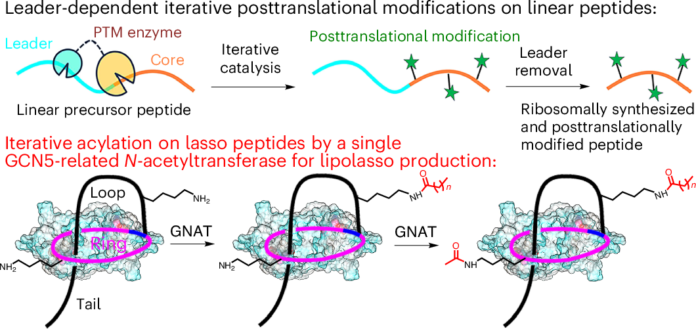
Widespread acetyltransferases found iteratively modifying mature lasso peptides source image 1
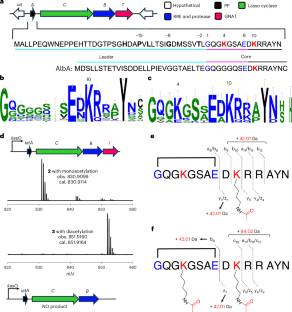
Source article image 2

Ribosomally synthesized and post-translationally modified peptides, or RiPPs, are prized for the chemical variety they can achieve from relatively small genetic blueprints. A new study shows that this diversity can be expanded even further after a peptide has already folded into one of the most architecturally constrained RiPP classes: the lasso peptide.

In the work, the authors describe a widespread group of GCN5-related N-acetyltransferases, or GNATs, that do something unusual for iterative enzymes. Instead of acting on a flexible linear peptide, these enzymes can recognize a mature lasso peptide and acetylate two lysine residues one after the other, placing modifications on both the loop and ring regions of the folded molecule.

That matters because lasso peptides are not easy substrates. Their threaded, knotted-like topology creates a compact three-dimensional shape that typically demands highly tailored enzyme-substrate interactions. To understand how one of these enzymes, IatT, handles such a challenging target, the researchers combined enzymatic reconstitution with high-resolution cryo-electron microscopy.

The structural work revealed the binding pocket used by IatT to engage the lasso peptide and highlighted residues that help separate the first acetylation event from the second. In other words, the enzyme appears to use a single active site architecture to carry out two related but distinct steps on the same folded substrate.

The most practical result came from protein engineering. By reshaping the acetyl-recognition site, the team expanded the cavity enough to accept longer acyl groups. That turned the enzyme into a tool for generating new acylated lasso peptides, including a newly framed category the authors describe as lipolasso peptides.

Because GNAT-encoding genes are common across RiPP biosynthetic gene clusters, the strategy could have broad reach. Rather than discovering one-off pathways for each new scaffold, researchers may be able to repurpose similar enzymes to diversify peptide natural products more efficiently and create ribosomal lipopeptides with new properties.

The study adds to a growing picture of RiPP biosynthesis as a modular platform for late-stage editing. It also shows that mature, highly structured peptides are not necessarily off-limits to iterative tailoring enzymes, opening a route to engineered products that sit at the intersection of peptide natural products and lipopeptide chemistry.

GLP-1 Race Heats Up as Structure Advances, Rhythm Misses, and Novo Faces FDA Scrutiny

0
GLP-1 Race Heats Up as Structure Advances, Rhythm Misses, and Novo Faces FDA Scrutiny

The obesity-drug market stayed firmly in focus this week, with fresh clinical readouts and regulatory headlines underscoring just how competitive — and scrutinized — the field has become.

Structure Therapeutics posts encouraging Phase 2 data

Structure Therapeutics drew attention after reporting that its investigational oral GLP-1 candidate produced meaningful weight loss in a Phase 2 study. Analysts described the profile as competitive versus other oral incretin programs, including candidates being developed by Eli Lilly and Novo Nordisk.

According to investor commentary cited in the market, the drug delivered 16.3% weight reduction after 44 weeks, a result that strengthens the case for oral peptide-inspired therapies as a major battleground in obesity treatment.

Rhythm falls short in genetically driven obesity trial

Not every obesity program had a strong week. Rhythm Pharmaceuticals announced that Imcivree did not meet expectations in a Phase 3 basket trial designed to evaluate several forms of genetically linked obesity. The setback is a reminder that rare-disease and precision-obesity programs can be highly sensitive to trial design and patient selection.

Lilly warns on compounded tirzepatide

Outside the clinic, Eli Lilly issued a public warning about the possible safety risks associated with compounded tirzepatide products. The company markets tirzepatide as Zepbound for obesity and Mounjaro for type 2 diabetes, and the warning adds to an ongoing debate over the quality and oversight of compounded versions of popular GLP-1 and dual-agonist medicines.

Novo Nordisk receives FDA warning letter

Novo Nordisk is also dealing with regulatory pressure after the FDA issued a warning letter concerning adverse-event reports potentially linked to Ozempic. The agency said the company did not adequately investigate certain reports, including three deaths that had been flagged as possibly associated with the drug.

The letter lands at a difficult time for Novo, which has already faced investor concerns and a cooling in sentiment around one of the industry’s most visible obesity franchises.

Broader policy and FDA tensions continue

Beyond the obesity space, a federal judge in Massachusetts found that Health Secretary Robert F. Kennedy Jr.’s effort to reshape vaccine policy was likely unlawful, narrowing the path for his attempt to overhaul the CDC’s immunization advisory structure. The ruling could have implications for how aggressively the administration can pursue vaccine-policy changes going forward.

Meanwhile, FDA controversies continue to build, including fresh scrutiny from lawmakers over drug-review decisions and questions surrounding senior agency personnel transitions.

What it means for peptide investors

For peptide and metabolic-disease watchers, the message is clear: oral incretin programs are still gaining momentum, but the commercial opportunity comes with rising regulatory risk. Clinical differentiation alone may not be enough; companies will also need clean safety narratives, strong manufacturing control, and a careful public-policy posture.

AstraZeneca Moves to Build Shanghai Cell Therapy Manufacturing Hub

0
AstraZeneca Moves to Build Shanghai Cell Therapy Manufacturing Hub

AstraZeneca is taking a major step toward building a full cell therapy footprint in China, announcing plans for a commercial manufacturing base in Shanghai’s free trade zone. The site is intended to supply CAR-T therapies for China and additional Asian markets, supporting the company’s push to become a leading global player in end-to-end cell therapy development and production.

The move follows AstraZeneca’s broader commitment to invest more than $15 billion in China by 2030. That pledge includes expanding capabilities across advanced therapies, and the Shanghai facility now adds concrete detail to that strategy. Alongside the manufacturing base, the company also plans to open an innovation center in the city to support early research, viral vector and plasmid work, analytical testing, and clinical manufacturing.

One of the central programs tied to the new infrastructure is AZD0120, AstraZeneca’s autologous BCMA/CD19 dual-target CAR-T candidate. The therapy came into the portfolio through the company’s acquisition of Gracell Biotechnologies, and it is now advancing through a global Phase 3 trial in multiple myeloma. AstraZeneca is also studying the platform in autoimmune diseases such as lupus, multiple sclerosis, and rheumatoid arthritis.

Autologous cell therapies come with a demanding logistics chain: patient T cells must be collected, processed, engineered, and returned quickly and reliably. That makes manufacturing capacity a critical factor in whether a program can scale commercially. AstraZeneca appears to be addressing that challenge directly by investing across the supply chain rather than relying on a single production step.

The company’s strategy also reflects lessons from the wider CAR-T field, where manufacturing bottlenecks and supply issues have slowed launches for some developers. By building facilities in Shanghai and deepening its local scientific presence, AstraZeneca is aiming to reduce those risks while strengthening its position in one of the world’s most important biotech markets.

Beyond manufacturing, the company says it is working with partners in China and the U.K. on a collaboration program designed to combine Chinese innovation with global scientific and financial resources. The initiative suggests AstraZeneca is not only building infrastructure, but also trying to create a broader ecosystem around next-generation cell therapies.

Geopolitical Volatility May Send Investors Toward Biopharma, Analysts Say

0
Geopolitical Volatility May Send Investors Toward Biopharma, Analysts Say

Heightened conflict in the Middle East is adding another layer of uncertainty to global markets, and one Wall Street team thinks biopharma could be one of the places investors look for shelter.

In a recent note, Truist Securities argued that commercial-stage biopharma has historically held up better than the broader market during periods of geopolitical stress. The firm reviewed several market shocks from the last few years, including the war in Ukraine and earlier bouts of Middle East-driven turbulence, and found that healthcare-focused names have generally been less volatile than the S&P 500.

Within the sector, the healthcare and pharma-heavy XLV ETF has tended to show steadier performance than the more speculative biotech basket represented by XBI. That split matters: larger, revenue-generating companies often attract defensive capital during risk-off periods, while smaller biotech firms can become more volatile and, for some investors, more attractive on pullbacks.

Truist said the recent backdrop suggests investors are not pricing in the same degree of downside risk they were at the height of earlier geopolitical scares. The implication is that both large-cap pharma and select biotech names may benefit from a rotation into sectors seen as less tied to the economic cycle.

For large pharmaceutical companies, direct exposure to Middle East demand appears limited. Truist estimated that most major players derive only a modest share of sales from the region, with GSK and Takeda among the highest at roughly 6%. Even so, their broader U.S. and European businesses should help cushion any regional disruption.

The analysts also pointed to a few names that could see indirect benefits if tensions persist. Amgen, for example, produces products included in government stockpiles for radiological or nuclear emergencies, while Gilead and Regeneron have procurement eligibility and manufacturing ties with the government.

For investors, the takeaway is simple: when uncertainty rises, biopharma can move from growth story to defensive trade. And in the biotech segment, that can create opportunity for those willing to tolerate a longer runway and more price swings.

Why Biopharma May Attract Defensive Capital as Middle East Tensions Shake Markets

0
Why Biopharma May Attract Defensive Capital as Middle East Tensions Shake Markets

As renewed conflict in the Middle East pressures global risk assets, some investors may be looking for sectors that can absorb volatility better than the broader market. According to a recent Truist Securities note, biopharma could serve that role, with commercial-stage healthcare names standing out as a relatively steadier place to deploy capital during periods of geopolitical uncertainty.

Truist examined several major disruptions from the past few years, including the escalation of war in Ukraine, broader Middle East tensions, and the 2024 Iranian missile attack. Across those episodes, the firm found that healthcare-focused equities generally held up better than the S&P 500, with lower swings in share prices and a more defensive profile. In particular, the State Street Health Care Select Sector ETF appears to have behaved more like a shelter than a source of stress.

Biotech, however, is not a single trade. Truist noted that the S&P Biotech ETF has been more sensitive to risk rotation, especially for pre-commercial companies whose valuations depend heavily on future clinical and regulatory milestones. That can make the group more volatile in the short term, but it can also create opportunities when prices weaken. For investors willing to tolerate a longer time horizon, that pullback can be attractive entry territory.

The firm also pointed out that investors in uncertain periods often favor companies with established revenue streams, durable demand, and less economic cyclicality. That dynamic can benefit commercial biopharma names that offer strong franchises and relative value rather than pure growth speculation.

For large-cap pharma, direct exposure to the Middle East appears limited. Truist said the region represents only a small slice of sales for most companies, with GSK and Takeda standing out as the most exposed at roughly 6%. Even so, the analysts believe U.S. and European demand should remain the main support for the group if regional disruption continues.

There may also be niche winners if conflict persists. Truist highlighted Amgen as a company that could benefit from government preparedness spending, given its role in products such as Nplate and Neulasta, which are included in stockpiles for radiological or nuclear emergencies. Gilead and Regeneron were also cited for procurement eligibility and manufacturing ties with the government.

The broader message from the note is that healthcare is once again being viewed through a defensive lens. In a market shaped by headlines and uncertainty, biopharma may not be immune to swings, but it could still offer a comparatively calmer path for capital seeking shelter.

AstraZeneca Moves to Build Shanghai Cell Therapy Manufacturing Base

0
AstraZeneca Moves to Build Shanghai Cell Therapy Manufacturing Base

AstraZeneca is taking a major step toward building an end-to-end cell therapy presence in China with plans for a commercial manufacturing base in Shanghai. The site, located in a free trade zone, is intended to support production of CAR-T therapies for China and additional Asian markets.

The move adds concrete detail to the company’s previously announced commitment to invest more than $15 billion in China by 2030. At the time, AstraZeneca said the capital would expand capabilities across several therapeutic areas, including cell therapies, while signaling an ambition to become the first global drugmaker with full cell therapy capabilities in the country.

One of the key assets tied to this strategy is AZD0120, a BCMA/CD19 dual-target autologous CAR-T candidate acquired through AstraZeneca’s purchase of Gracell Biotechnologies. The therapy is now being advanced in a global Phase 3 study in multiple myeloma, following earlier-stage work in autoimmune diseases such as lupus, multiple sclerosis, and rheumatoid arthritis.

Because AZD0120 is manufactured from a patient’s own T cells, the supply chain is central to its commercial viability. That means collecting cells, transporting them to the plant, running the manufacturing process, and returning the final product to the patient in a timely way. For CAR-T developers, this logistics-heavy model has been one of the biggest obstacles to broad adoption.

AstraZeneca appears to be addressing those challenges by building out more of the stack. In addition to the commercial manufacturing base, the company says it will open an innovation center in Shanghai focused on early-stage research, viral vector and plasmid development, analytical testing, and clinical manufacturing support.

The expansion also deepens AstraZeneca’s footprint in a city already important to its global R&D network. It comes as the company continues to invest in China while managing a complicated operating environment and working to strengthen local partnerships.

For the broader cell therapy field, the announcement underscores a familiar lesson: scientific promise is only part of the equation. If autologous therapies are going to scale, manufacturing reliability and regional infrastructure will matter just as much as trial data.

Bicycle Therapeutics Cuts Workforce by 30% After Reworking Its Lead Cancer Program

0
Bicycle Therapeutics Cuts Workforce by 30% After Reworking Its Lead Cancer Program

Bicycle Therapeutics is shrinking its workforce by about 30% as the company resets priorities around its oncology pipeline and pulls back from its lead program, zelenectide.

The biotech disclosed the move in its March 17 financial report, saying the restructuring is part of a broader strategic reprioritization. Based on a year-end headcount of 288 full-time employees, the reduction could affect roughly 86 positions. A company spokesperson later said about 200 employees will remain after the reorganization.

The decision comes after Bicycle received feedback from the FDA indicating that one of the studies supporting zelenectide is no longer viewed as an acceptable approval route. The company had been aiming to use data from the program to support a filing in metastatic urothelial carcinoma, but that plan is now on hold.

As part of the reset, Bicycle is also winding down two Phase 1/2 trials of zelenectide, including studies in breast cancer and non-small cell lung cancer. Together, the moves suggest the company is tightening focus on programs with a clearer development path while cutting back on work that no longer fits its near-term strategy.

For a biotech built around targeted peptide-drug conjugate technology, the shakeup is significant. Bicycle has long positioned its platform as a way to deliver precision cancer therapies, but the latest restructuring shows how quickly clinical and regulatory setbacks can force a company to rethink both its pipeline and its operating model.

The layoffs add Bicycle to a growing list of biopharma companies making cost-cutting decisions in 2026 as the sector continues to balance cash preservation, regulatory risk, and the pressure to show progress with lead assets.

R1 Therapeutics Raises $77.5M to Advance AP306 for Kidney Disease

0
R1 Therapeutics Raises $77.5M to Advance AP306 for Kidney Disease

R1 Therapeutics has emerged with a substantial Series A round, securing $77.5 million to push forward AP306, a phosphate-lowering candidate for chronic kidney disease.

The California-based startup says AP306 is designed as a pan phosphate transporter inhibitor, a mechanism the company describes as distinct from existing phosphate binders because it targets active phosphate transport. According to R1, that could translate into stronger control of serum phosphate with a lower pill burden for patients.

The financing was co-led by Abingworth, F-Prime, and DaVita Venture Group. R1 plans to use the capital to support global development of the asset and to prepare a Phase 2b study with partner Alebund Pharmaceuticals later this year.

AP306 already has Phase 2a data from China, where treatment was associated with a meaningful reduction in serum phosphate levels. In that study, a greater share of patients reached guideline-recommended phosphate ranges compared with Sanofi’s Renvela.

The program has an interesting origin story as well. AP306 was initially developed by Chugai and later licensed to Alebund, which granted R1 an exclusive worldwide sublicense outside Greater China. Financial details of that arrangement were not disclosed.

“AP306 has the potential to deliver superior efficacy with substantially lower pill burden compared to current phosphate binder therapies,” R1 CEO Krishna Polu said in the company announcement.

The same fundraising day also saw new capital for other biotech programs, including Mestag Therapeutics and iDEL Therapeutics, underscoring continued investor interest in oncology and platform-driven drug development.

Excalipoint Therapeutics Launches With $68.7M to Push Tri-Specific T Cell Engagers in Cancer

0
Excalipoint Therapeutics Launches With $68.7M to Push Tri-Specific T Cell Engagers in Cancer

Excalipoint Therapeutics has emerged from stealth with a sizable $68.7 million seed package and a clear goal: build a new generation of T cell-based cancer therapies for tumors that remain notoriously hard to treat.

The Shanghai-based startup’s financing was structured in two parts, beginning with a $41 million launch round when the company was founded in August 2025, followed by a $27.7 million extension that drew support from MPCi and Centurium Capital. Lilly Asia Ventures joined the extension, alongside Eisai Innovation, underscoring continued investor appetite for engineered immuno-oncology platforms in China.

At the center of the company’s strategy is a pipeline of six assets it believes could stand out in a crowded field of bispecific and next-generation T cell engagers. The lead program, EXP011, is a tri-specific antibody designed to recognize DLL3, CD3 and 4-1BB. Excalipoint is developing it for small cell lung cancer and neuroendocrine tumors, two indications where treatment options are limited and durable responses remain elusive.

The company has already moved EXP011 into the clinic, with a Phase 1/2 study underway and first patient dosing completed in October 2025. That early clinical momentum may help Excalipoint generate human data faster as it works to validate both safety and target engagement.

Another disclosed program, EXP012, also uses a tri-specific format and is intended to bind CDH17, CD3 and 4-1BB. The candidate is being positioned for colorectal, gastric and pancreatic cancers, reflecting the company’s interest in tumors with substantial unmet need and limited immunotherapy penetration. A third candidate, EXP016, is aimed at difficult solid tumors, though the company has not yet revealed its molecular targets.

Beyond its drug candidates, Excalipoint is also promoting a set of proprietary technologies designed to support its platform. These include TOPAbody for constructing tri-specific molecules, T-Cell Immune Shield for improving specificity and potency, and TCE Probody for potentially opening up targets that have been difficult to drug with conventional approaches.

CEO Lei Fang, who previously held leadership roles at Lepu Biopharma and I-Mab Biopharma, framed the company’s launch as a combination of scientific design and China’s development speed. That combination has become increasingly attractive to global biopharma, as China continues to offer dense patient pools, fast clinical execution and a more streamlined regulatory environment than many Western markets.

For investors and drug developers alike, Excalipoint’s debut reflects a broader trend: growing confidence that China can do more than manufacture or run trials for global programs. It is increasingly becoming a source of novel oncology innovation, especially in areas like cell therapies, radioconjugates and engineered antibodies where rapid iteration can create an edge.

Whether Excalipoint’s tri-specific approach can translate into differentiated clinical outcomes remains to be seen, but the company now has the capital, platform and first-in-human program needed to test that thesis.

Hello world!

1

Welcome to WordPress. This is your first post. Edit or delete it, then start writing!